

At Code-it Hacks Kids summer camps, we introduce kids to coding in a fun and educational way. VR coding camps focus on teaching the fundamentals of game development, enabling young learners to design and build their games from scratch.
Virtual reality is shaping how games are played, how simulations are built, and how immersive digital worlds are experienced. But behind every VR experience is careful design across camera perspective, movement, interaction, scale, and usability.
In our VR camps, students don’t just use virtual reality. They learn how immersive experiences are designed, coded, tested, and refined, layer by layer.
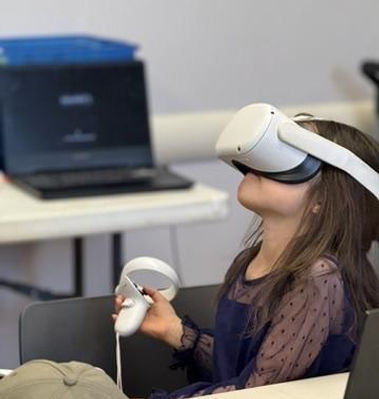
It’s where coding meets creativity, and imagination becomes immersive.

VR Light - ROBLOX STUDIO
Immersive design · Guided creation · Age-appropriate depth
VR Light introduces students to how games & virtual worlds feel in virtual reality. Using Roblox, students build 3D worlds and games, then playtest their creations in VR to understand how perspective, scale, camera movement, and usability change in immersive environments.
Key Focus Areas:
-
Building 3D worlds and Game assets in Roblox
-
Gameplay creation using age-appropriate tools
-
Ages 7–9: Coding fundamentals with pre-written and guided scripts
-
Ages 10–14: Coding fundamentals with a deep dive into Lua scripting
-
-
Playtesting games in VR to evaluate immersion & comfort
-
Camera, lighting, scale, and object placement for VR
-
Immersive design concepts without native VR complexity

VR Deep - UNITY GAMING ENGINE
Native VR development · Real systems · Advanced interaction
VR Deep is designed for teens ready to build fully functional virtual reality experiences. Using Unity, students develop native VR games and simulations with real interaction systems, movement mechanics, and immersive environments.
Key Focus Areas:
-
Native VR development using Unity
-
Interaction systems for VR controllers and movement
-
Physics, scale, and spatial interaction
-
Testing and refining comfort and immersion
-
Advanced projects with intelligent NPC behaviour and interactive systems
-
Understanding how professional VR experiences are built
What’s the Difference Between VR Light and VR Deep?
The key difference between VR Light and VR Deep is how deeply students move from understanding immersive design to building native virtual reality systems, and the level of technical complexity they’re ready for.
Both VR Light and VR Deep are designed to help students understand how immersive experiences work and to build confidence as creators, not just consumers, of virtual worlds.
Why Kids Love VIRTUAL REALITY (and Why That’s a Good Thing)
EXPRESS CREATIVITY
Kids design their own game world, objects, and characters
Tools to be creators, not just consumers
Playground for problem-solving
They use problem-solving and creativity at every step, balancing coding, logic, art, and design.
VR taps into what kids love most: creation, challenge, and adventure - on their terms.
SIMPLICITY in Complex Topics
Just logic, puzzles, and imagination.
Kids control how worlds are made, how stories unfold, and how players interact.
IMMERSIVE Game Building
Immersion helps concepts like perspective and space make sense quickly.
Experimenting is part of the fun. Kids enjoy adjusting layouts, lighting, and object placement to improve their games.
VR introduces immersive technology thoughtfully, helping kids learn how virtual experiences work without overexposure or overwhelm.
Imagine NOT just building a game - but stepping inside it.
The VR Magic
Centrepiece of our ROBLOX and UNITY Game Design Summer Camps
Why Learning VR Through ROBLOX and UNITY Matters in 2026?
The world is shifting from flat screens to immersive experiences, and kids are the next generation of creators.
Virtual reality and immersive technologies are expanding beyond entertainment and becoming core tools in education, training, design, and simulation across industries.
Global AR/VR market
Expanding user Base
Industry Reach
VR Job Market
The global AR/VR market is projected to grow at a ~28% compound annual growth rate through 2030, reaching tens of billions in value
The VR software market is expected to reach 200+ million users worldwide by 2030, indicating widespread adoption.
60% of all gaming studios are investing in AR/VR
VR is changing industries from healthcare to education training to engineering
Job postings related to AR/VR and immersive technology have increased by 150%+ over the past five years.
"In VR Coding camps, kids aren’t just telling stories, they’re building entire universes.”
Why Parents & Kids Love Our VR Camps
-
Engaging curriculum designed by real tech educators
-
Balance of structure, creativity, and fun
-
Tech skills taught in a screen-positive, age-appropriate way
-
A chance to build and launch real games!
We Teach Kids To:
-
Think critically about the games they play
-
Prioritize safety and kindness in online spaces
-
Understand the difference between passive play and purposeful creation
-
Practice screen time moderation
Why Parents Opt for Code-it Hacks Kids VR Camps?
VR LIGHT ROBLOX CAMP
-
VR is used intentionally, not constantly
Headsets are introduced in short, guided sessions focused on learning goals rather than free play. -
VR supports learning, not screen time
Most of the camp is spent building, discussing, and improving games. VR is used specifically for playtesting and evaluation. -
Instructor-led at all times
All VR activities are guided and supervised by instructors. -
Comfort and safety come first
Session length, movement, and student comfort are actively monitored. -
No independent or unstructured VR use
Every VR session has a clear purpose and learning objective. -
Skills go beyond VR
Students develop spatial reasoning, design thinking, and problem-solving skills that apply across technology and STEM learning.

VR Deep UNITY CAMP
-
Built on real development foundations
Students work with Unity and structured programming concepts to build native VR experiences. -
Guided rigour, not free exploration
Instructors support complex learning while encouraging independence and ownership. -
Intentional VR use
VR is used for development, testing, and refinement, not constant headset time. -
Comfort and safety are part of the curriculum
Students learn how developers design for motion, scale, and usability. -
Advanced concepts are introduced thoughtfully
Later projects may include intelligent NPC behaviour and interactive systems. -
Transferable skills
Students develop systems-thinking, problem-solving, and persistence skills that extend beyond VR.

What they learn now could shape their future
They're not just keeping up, they’re getting ahead of the curve.
Sample Day Schedule
Activity | Time |
|---|---|
MORNING CARE | 8:00 - 9:00 AM |
CHECK-IN | 8:45 - 9:00 AM |
STEM Lesson | 9:00 - 9:30 AM |
COLLAB CORNER | 9:30 - 9:45 AM |
DESIGN BENCH
Inquiry Segment | 9:45 - 10:00 AM |
BREAK | 10:00 - 10:15 AM |
BUILD - CODE Time | 10:15- 12:00 PM |
LUNCH
OUTDOOR TIME | 12:00 - 1:30 PM |
STEM LESSON | 1:30 - 2:30 PM |
BUILD - CODE | 2:30 - 4:15 PM |
NEW:
THE FUN HOUR | 4:15 - 4:45 PM |
PICKUP | 4:00 - 4:15 PM |
AFTERCARE | 4:00 PM - 5:00 PM |


VR CAMPS 2026
ROBLOX and UNITY
Roblox 3D VR Game Development with Lua Coding

ROBLOX DEVELOPER + VR - LUA CODING
July 27th - July 31st , 2026
Ages 10 - 17
Roblox 3D Game Design and VR Experience - Pokemon Catcher

ROBLOX GAME DESIGN + VR
July 6th - July 10th, 2026
Ages 7 - 9
UNITY - COSMIC ENTERPRISE - GALACTIC TYCOON

VIRTUAL REALITY AI EDITION
Aug 10th - Aug 14th, 2026
AGES: 10 - 17
In Cosmic Enterprise: Galactic Tycoon, teens in AI become system designers and simulation engineers, building a 3D VR space-themed tycoon game using Unity and C#. Rather than focusing on fast-paced action, this camp challenges teens to design intelligent systems—from resource management and automated production to NPC behaviour and economic balance. Students build a living galaxy where decisions matter, and systems react. This camp introduces teens to AI as systems thinking, showing how intelligence emerges from rules, data, and feedback loops. It’s an ideal experience for students interested in AI, game design, simulations, economics, or engineering.
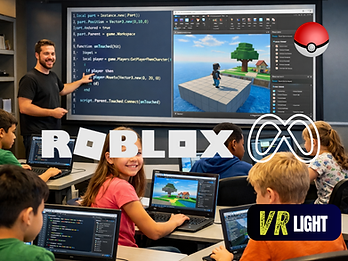
Roblox 3D VR Game Development with Lua Coding- Pokemon Catcher
ROBLOX DEVELOPER + VR - LUA CODING
July 6th - July 10th, 2026
Ages 10 - 17
Roblox 3D Game Design and VR Experience - Rainbow Obby

ROBLOX GAME DESIGN + VR
July 27th - July 31st , 2026
Ages 7 - 9
UNITY - GOTHAM CITY - SKYLINE DEFENDERS

VIRTUAL REALITY AI EDITION
July 20th - July 24th, 2026
AGES: 10 - 17
In Gotham City: Skyline Defenders, teens in AI become game developers and AI system designers, building a 3D Gotham-inspired city. Using Unity VR edition and C#, teens create a fully playable 3D city where: Enemies patrol intelligently across districts. Defence systems adapt to rising threats, and NPCs react based on player decisions
The city evolves as the game progresses. Students design foundational AI systems used in professional Unity games, including state-based behaviour, pathfinding, and adaptive gameplay. Teens design and build for VR, testing how immersive perspectives impact strategy and player experience. This camp blends cinematic storytelling, AI systems design, and professional game development tools, giving teens both context and challenge as they build a living, intelligent city.
Let’s Turn Screen Time into Skill Time
I'm a paragraph. Click here to add your own text and edit me. It's easy.