

Right level, right pace: two tracks (4–5 and 6–7) avoid boredom or overwhelm.
Two age tracks: Ages 4–5 (screen-light) and Ages 6–7 (balanced screens)
SPARK replaces one-off classes with a clear pathway where kids learn to think like problem-solvers: plan steps (algorithms), look for patterns (loops), test ideas, and explain their fixes (debugging), tinker with circuits, understand structures, fore and energy, and build Robots with LEGO: the core of computational thinking that benefits every subject.
SPARKLAB STEM JOURNEY & Programs
Ages 4 - 5
Play-based exploration of patterns, sequences, and cause & effect. Students tinker, build confidence, and spark curiosity about how technology works.
Ages 6 - 7
Extends foundational learning into simple coding, problem-solving, and early project creation. Builds readiness for the next stage.
Common Across the SPARKLAB TRACK
Class Format
28 weeks, 1 session/week, 75 minutes each. Small class (max 8)
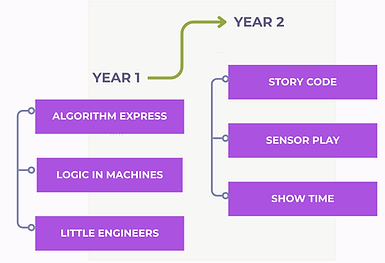
Foundational + Year 2
with each age track + Year-end STEM FESTIVAL
Core strands (spiralled all year):
Pedagogical Pillar
CAPSTONE PROJECT YEAR-END STEM FESTIVAL
Computational skills
Tangible Math
Engineering & Circuits
Lego Robotics
Storytelling with Code
Maker Product Development
Foundational Computational Thinking:
Play-Based Design Thinking
Collaboration & Communication
Confidence & Creativity
Students will complete a Capstone project based on their learning from the year. The project will be showcased in our Year-End STEM FESTIVAL, open to Parents and friends
TANGIBLE FOUNDATIONS
Ages 4 - 5.
COMPUTATIONAL & MATH SKILLS
SIMPLE algorithms design and execution to understand sequences, patterns and solve multiple puzzle challenges
LOGIC, LOOPS & DEBUG
When/then rules, repeat patterns and loops. simple timing: predict, run, explain. DEBUGGING habit: change one thing and re-test
LEGO ENGINEERING & CIRCUITS
Engineering + Circuits: sturdy builds (wheels, gears, ramp, etc.). Circuit builds and test: switches, lights and sounds.
GRADUATE
Ready for Block-based coding in YEAR 3: Foundations in Motion
FOUNDATIONS IN MOTION
Ages 6 - 7

COMPUTATIONAL & MATH SKILLS
Block-based designing and exciting algorithms to decompose complex tasks, identify patterns, understand distances and degrees, code puzzles and mazes, and complete multiple challenges.
LOGIC, LOOPS & DEBUG
Loop events, simple if, data-lite state(start, reset, score). Debugging habit: change one thing and re-test
LEGO ENGINEERING & CIRCUITS
Sensors + Lego mechanisms working together to solve every-day problems
GRADUATE
Design & Presentation: iterate from feedback; Ready for IGNITE LAB JOURNEY
What makes SPARKLAB different?
Hands-on LEGO® Robotics
Our "BUILD - FIRST" Rhythm
01
Why this matters: Kids don’t just “use a robot”; they build motion first and then code it. That sequence makes cause-and-effect visible (gear choice → speed, wheelbase → turning) so programming is predictable, testable, and explainable.
-
Thinking with hands: regular build then code cycles across the term grow spatial reasoning, fine motor control, and persistence.
-
Code that maps to reality: step size, turns, loops, and events are tied to real movement kids can predict and describe.
-
Understanding compounds: concepts resurface in new challenges, so learning deepens over time, not as a one-off activity.
Circuits & Electronics -
A recurring strand
02
Why this matters: Electricity isn’t a one-day demo; we revisit it so kids trust what a signal does every time!
-
Signals / rules: children connect inputs (switches/sensors) to outputs (light/sound/motion) a perfect bridge to event-driven coding.
-
Stepwise confidence: open/closed circuits, polarity, simple series/parallel, always age-safe and hands-on.
-
Control mindset: tiny changes in a circuit change behaviour, the seed of systems thinking.
Why this matters: We don’t guess; we measure, test, and improve like engineers.
Engineering & Design real mechanics & physics
03
-
Structural + mechanical: sturdy frames and moving parts (wheels, axles, gears, linkages).
-
Evidence first: multiple short test–debug cycles most sessions with numbers kids can track (tile lengths, 90° turns, loop counts, timing).
-
Physics made friendly: pushes/pulls, friction, ramp height, speed, and stopping distance are felt, not lectured.
-
Predict, Run, and Explain: no “black box” learning; kids say what will happen and why.
-
Cleaner plans: algorithms become loops and simple if/when rules.
-
Real debugging: change one thing, re-test, tell what changed—calm problem-solving that transfers to school.
04
Computational Thinking "The thinking toolkit"
Why this matters: We teach the habits behind coding, not just blocks on a screen.
05
Maker & Entrepreneur Mindset
Why this matters: Kids see themselves as creators who improve the world around them.
-
User-aware making: choose an audience (family, peers), set a purpose, and design to meet it.
-
Iterate from feedback: test with others, refine, and try again—resilience in action.
-
Present & pitch: short demos build voice, confidence, and clarity.
-
Resourcefulness: work within simple constraints (time, parts) to deliver a solution—early entrepreneurial thinking.
06
Two age tracks. Tiny groups
Why this matters: Just the right level, just the right pace, with real attention.
-
Separate tracks: Ages 4–5 (screen-light) and Ages 6–7 (balanced screens) keep challenge in the sweet spot.
-
Small by design: max 8 learners with Instructor + Coach = less waiting, more doing.
-
Built-in scaffolds: role rotations (driver/navigator/builder), “challenge ladders,” and plain-language “I can…” goals make progress visible.
What Parents can Expect

What parents can expect ?
-
Joyful confidence: Your child feels proud to show what they built and can tell you how it works in simple language.
-
Early problem-solving: They learn to try, fix, and try again—building patience and resilience without tears.
-
Foundational thinking: Gentle exposure to patterns, sequencing, and cause-and-effect through play.
-
Hands-on creativity: Storytelling + LEGO® builds spark imagination and curiosity about how things move and work.
-
Positive habits: Turn-taking, sharing ideas, and celebrating effort as much as outcomes.
PRICING & SCHEDULE
SPARKLAB
Ages 4 - 7
DATE & TIME:
SATURDAYS @ 9:30 am - 10:45 am
OCTOBER 17th - JUNE 12th
28 Weeks | 75-minute:
Full-Year Program
PRICE: $1490 + HST (Payment plan options available at checkout)
IGNITELAB
Ages 8 - 12
OCTOBER 17th - JUNE 12th
SATURDAYS @ 11:00 am - 12:30 pm
DATE & TIME:
28 Weeks | 90-minutes:
Full-Year Program
PRICE: $1590 + HST (Payment plan options available at checkout)
PIONEERSLAB
TEENS Ages 13+
OCTOBER 17th - JUNE 12th
SATURDAYS @ 12:45 pm - 2:45 pm
DATE & TIME:
28 Weeks | 2 Hours:
Full-Year Program
PRICE: $1850 + HST (Payment plan options available at checkout)